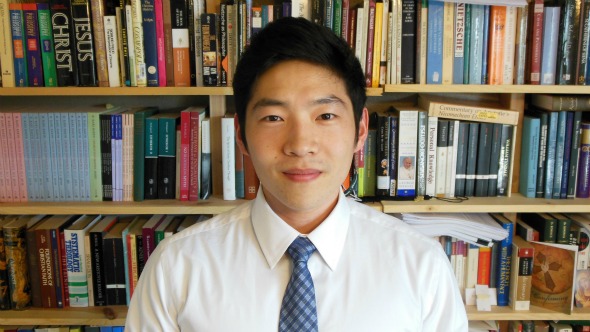
Joshua Lim graduated this Spring from Westminster Seminary California, where he earned his MA in historical theology. He was born and raised in the PCUSA. He spent a few years in college as a Baptist before moving back to a confessional Reformed denomination (URCNA) prior to entering seminary. He was received into full communion with the Catholic Church this year on April 21st, the feast day of St. Anselm. In this CTC article, he explains how he came to be Catholic during his final year at a Presbyterian seminary.
Continue readingMonday, May 28, 2012
Friday, May 25, 2012
“Too catholic to be Catholic?” A Response to Peter Leithart
Peter Leithart, a fellow at New St. Andrews College, pastor of Trinity Reformed Church in Moscow, Idaho, and contributor to journals such as First Things and Touchstone recently posted an article titled "Too catholic to be Catholic." The article has been widely shared and discussed, provoking both approval and criticism from different groups of persons. Leithart followed up his article with a response to one common criticism; his response is titled "Israel, Idolatry, and Separated Brothers." A good evaluation of Leithart's argument, from a Catholic point of view, can be found here: "“Too catholic to be Catholic?” A Response to Peter Leithart."
Tuesday, May 22, 2012
An Opportunity to help Catholic Education
There are very few more prudent cultural investments than excellent primary education. See John Senior's books The Death of Christian Culture, and The Restoration of Christian Culture. See also Pope Pius XI's "Divini Illius Magistri," and his "Rappresentanti in terra, both on the subject of Christian education. I learned this week that a traditional Catholic K-12 school, John Paul the Great Academy in Lafayette, Louisiana, is facing a dire financial crisis, and could be forced to close. If you would like to help out the school, please visit their website and click on the "Support JPG" tab.
Tuesday, February 14, 2012
Making My Way to the Church Christ Founded
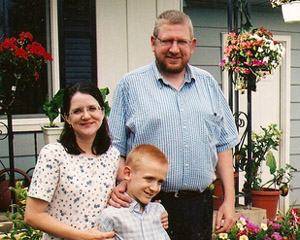
Fred Noltie was in the Presbyterian Church in America (PCA) for twenty years, attending both Covenant College and Westminster Theological Seminary in Philadelphia. On the Easter Vigil of 2005 he, his wife Sabryna, and their son were together received into full communion with the Catholic Church at St. Lawrence parish in Monett, Missouri, where they are presently members. In this article Fred tells the story how he and his family became Catholic. He writes:
In The Accidental Catholic I described how I realized that Protestantism’s proposed means for discerning revealed truth in the Bible do not afford us any basis for certainty about what that truth actually is. This fact, which struck me like a bolt out of the blue, forced me to realize that I could not remain a Protestant. But on the day that I decided that I was no longer Protestant I was equally certain that I would never become Catholic. I was just not interested in that at all, because – after all – it was the Catholic Church, and I just "knew" it was wrong! Why did I change my mind?
Continue reading
Tuesday, February 7, 2012
An OPC Pastor Enters the Catholic Church
Jason Stewart was an ordained minister in the Orthodox Presbyterian Church (OPC), having earned his Master of Divinity from Mid-America Reformed Seminary (Dyer, IN) in 2005, and subsequently served for 5 1/2 years as pastor of Trinity OPC in eastern Pennsylvania. He and his wife Cindy were received into full communion with the Catholic Church on January 10, 2011 at St. Jane de Chantal Catholic Church in Easton, PA. Many people have asked Jason why he became Catholic. Here, in the following article, he explains why he became Catholic. He writes:
"I hope to tell my story simply, because it is genuinely uncomplicated. Complex, yes. Multi-layered, sure. Who's journey in the Christian faith isn't? But I do promise to keep the telling of it simple by concentrating on the main catalysts that gave my wife Cindy and me the courage to approach the doors of the Catholic Church and with confidence begin to knock...."
(Continue reading)
Monday, January 30, 2012
A Response to Scott Clark and Robert Godfrey's “The Lure of Rome”
In November of last year, Scott Clark and Robert Godfrey, both professors at Westminster Seminary in California, made a podcast titled "The Lure of Rome," in which they attempted both to explain why so many Evangelicals and even Calvinists are becoming Catholic, and why such persons are mistaken in doing so. Andrew Preslar has written a helpful response to Clark and Godfrey, in which he takes up the issue of the development of doctrine, because in their argument against becoming Catholic, Clark and Godfrey presuppose the denial of the development of doctrine.
Andrew's article is titled "A Response to Scott Clark and Robert Godfrey on "The Lure of Rome"."
Sunday, October 30, 2011
Reformation Sunday 2011: How Would Protestants Know When to Return?
Imagine that the Occupy Wall Street protest continued for years, during which time the community of protesters divided into different factions, each with different beliefs, different demands, and different leaders. But the protests continued for so long that the protesters eventually built makeshift shanties and lived in them, and had children. These children grew up in the protesting communities, and then they too had children, who also grew up in the same communities of protesters, still encamped in the Wall Street district. Over the course of these generations, however, these communities of protesters forgot what it was that they were protesting. They even forgot that they were protesting. Life in the shanties in Wall Street was what these subsequent generations had always known. They did not even know that they had inherited a protesting way of life, separated from the rest of society. When asked by a reporter what Wall Street would have to change in order to get them to return home, they looked at him confusedly, and responded, "We are home; this is home." They no longer had any intention to 'return to society' upon achieving some political or economic reform. For them, camping out on Wall Street was life as normal, and those with whom they had grown up camping simply were their society. Continue reading
Wednesday, October 26, 2011
Into the Half-Way House: The Story of an Episcopal Priest
At Yale, there used to be an auxiliary library buried underneath the green in front the Sterling Memorial Library. One fine fall day, I happened to find myself not out amongst the foliage but rather tucked away below the sunshine and the sod, reading a book. I suppose it was an odd choice. This was the ugliest space I know of on an otherwise beautiful campus. So ugly, in fact, that it was targeted for a remodel and is now gone. But there I was, and perhaps even more odd, I, a good Anglican-priest-in-training, was reading Cardinal Newman. Not the good parts that we Anglicans agreed with; the parts about the Oxford movement and the Church Fathers. No, I was reading the Apologia; the story of his conversion to the Catholic Church. I was particularly bothered by one specific bit. Continue reading
Sunday, August 21, 2011
Philosophy and the Papacy
The Scripture readings for today's liturgy provide a biblical basis for the papacy, as John Bergsma explains. But as a Protestant, I was not able to see those verses as providing that basis, until I read Plato's Republic. Of the various philosophical factors that helped me become Catholic, one was teaching through Plato's Republic. I had taught it a few times before, but this time, I was teaching it with an eye toward its implications regarding unity. My conclusion was that for philosophical reasons we could expect Christ to have established for the Church an enduring office for her government, an office occupied by one person at a time. That conclusion allowed me to be more open and receptive to the Catholic understanding of Matthew 16:18-19, Luke 22:32, and John 21:15-17. So how did Plato's Republic help me reach that conclusion?
In order to explain the role of Plato's Republic in helping me become more open to the Catholic understanding of St. Peter's unique office in the Church, I need to lay out the broader line of reasoning to which it contributed. That line of reasoning was as follows.
(Continue reading)
Monday, August 15, 2011
Solemnity of the Assumption of the Virgin Mary
Today, August 15, is the Solemnity of the Assumption of the Virgin Mary into Heaven. On this day, the universal Church celebrates what took place at the end of our Blessed Mother’s earthly life. “The Immaculate Mother of God, the ever Virgin Mary, having completed the course of her earthly life, was assumed body and soul into heavenly glory.” This dogma is the great antidote to materialism and the moral corruption that follows despair, because in Mary’s Assumption into heaven we see our own glorious destiny as fellow creatures like her, united to her Son. In her Assumption we see the eschatological finale awaiting the Church, of which she is the icon.
This doctrine was not formally defined as a dogma until 1950, when Pope Pius XII did so in an Apostolic Constitution titled Munificentissimus Deus. Although the Orthodox have not formally defined the doctrine as a dogma, this doctrine is not a point of dispute between Catholics and Orthodox, because the Feast of the Assumption has been celebrated in the universal Church (both East and West) on this same date (August 15) since the sixth and seventh centuries. However, this doctrine is not accepted by most Protestants, and is therefore an occasion of difficulty with respect to the reconciliation of Protestants and the Catholic Church.
Recently Peter Leithart responded to Christian Smith's claim that sola Scriptura is the belief that Christians have "the Bible alone and no other human tradition as authority." Leithart protested against this definition, claiming that the Reformed do acknowledge the authority of tradition, but hold Scripture to have final authority. My response to Leithart can be found here, where I argue (briefly) that to subject tradition to the test of one's own interpretation of Scripture is to deny the authority of tradition, and thus to vindicate Smith's claim. ...
(Continue reading)